Industry Impact
It’s critical that we routinely examine shifts in industry performance to better understand where A&D stands today. This information helps us identify opportunities on the horizon for our workforce and businesses.
ANNUAL REPORT2026 Facts & Figures: U.S. Aerospace & Defense
Each year, AIA tracks the changes in the U.S. aerospace and defense industry. Among the metrics measured are employment rates, economic output, trade statistics, and state data. Key findings are highlighted here for an at-a-glance view of how the industry fared through the year.
Tracking State Data
In 2025, the industry supported jobs and communities in all 50 states and the District of Columbia.
A&D Economy Impact by State
Review the 2025 employment rates, industry revenue, value added, and tax receipts for your state in our annual state data report.
State of the Industry
The U.S. aerospace and defense industry remains a cornerstone of American economic strength and national security. Powered by a highly skilled workforce, a resilient supply chain, and sustained demand across commercial aviation, defense, and space, the industry continues to drive innovation, support high-quality jobs, and strengthen U.S. leadership in the global marketplace. Its role as a leading exporter and trusted partner to allies reinforces its importance to both economic competitiveness and security worldwide.
Note: The 2026 Facts and Figures report reflects the most current data for all years covered. Therefore 2025 and earlier statistics may be different than in previous “Facts and Figures” reports, reflecting updated data sets and the evolution of the industry. For any further questions on methodology, please contact [email protected].
Creating Jobs
AT-A-GLANCE

2.1M Workers

$266B in Compensation

Wages 40% Higher Than Average
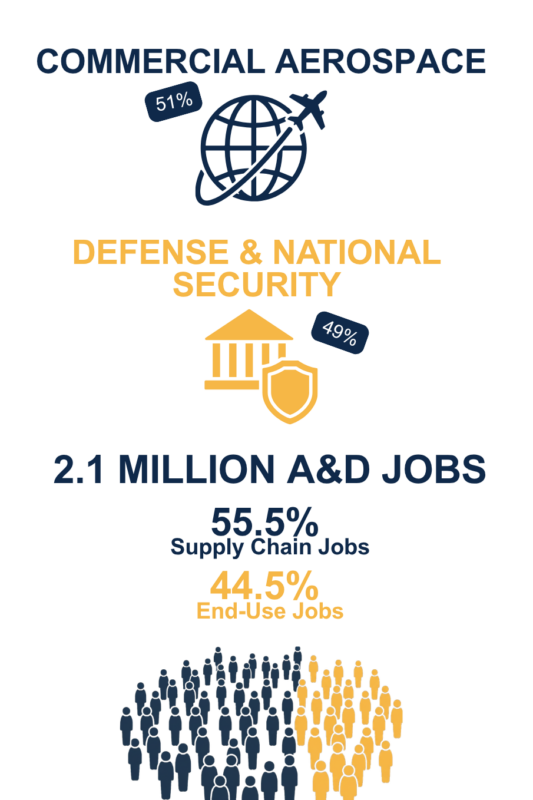
At the heart of the aerospace and defense industry is its workforce, powering the recovery of air travel, advancing more sustainable aviation technologies, delivering cutting-edge defense and deterrence capabilities, and enabling the future of space exploration. In 2025, the aerospace and defense workforce supported more than 2.1 million jobs across every state, representing a critical share of U.S. employment and underscoring the industry’s nationwide impact.
Wages and Benefits 40 Percent Higher Than the National Average
These are highly skilled, high-paying jobs, with average wages exceeding $127,000 — approximately 40 percent above the national average. In total, the industry generated $266 billion in labor income, reinforcing its role as a driver of economic opportunity and shared prosperity.
Supply Chain Employees Account for More Than Half of Aerospace and Defense Workforce
A majority of employment is supported by the aerospace and defense supply chain, an extensive network of suppliers made up of thousands of small and medium-sized businesses across the country. Supply chain companies account for roughly 1.1 million jobs, highlighting the depth and reach of the industry’s ecosystem. Employment is nearly evenly split between commercial aerospace at 51 percent and defense and national security at 49 percent, which highlights the essential partnership between these sectors and how they work together to drive innovation and economic growth.
Investment in the Aerospace and Defense Industrial Base
The industry invested $45 billion in total capital expenditures — up 13 percent from 2024 — supporting modernization, expanding production capacity, and strengthening long-term competitiveness in an increasingly dynamic global market. Original equipment manufacturers (OEMs) and related machinery subsectors accounted for $34.3 billion of these capital expenditures — an increase of nearly $5 billion in investments, or 17 percent, over 2024.
Workforce Makeup by Sector
Supporting the Economy
AT-A-GLANCE

1.6% of Total U.S. GDP

$500B in Economic Value

$989B in Total A&D Industry Sales Revenue
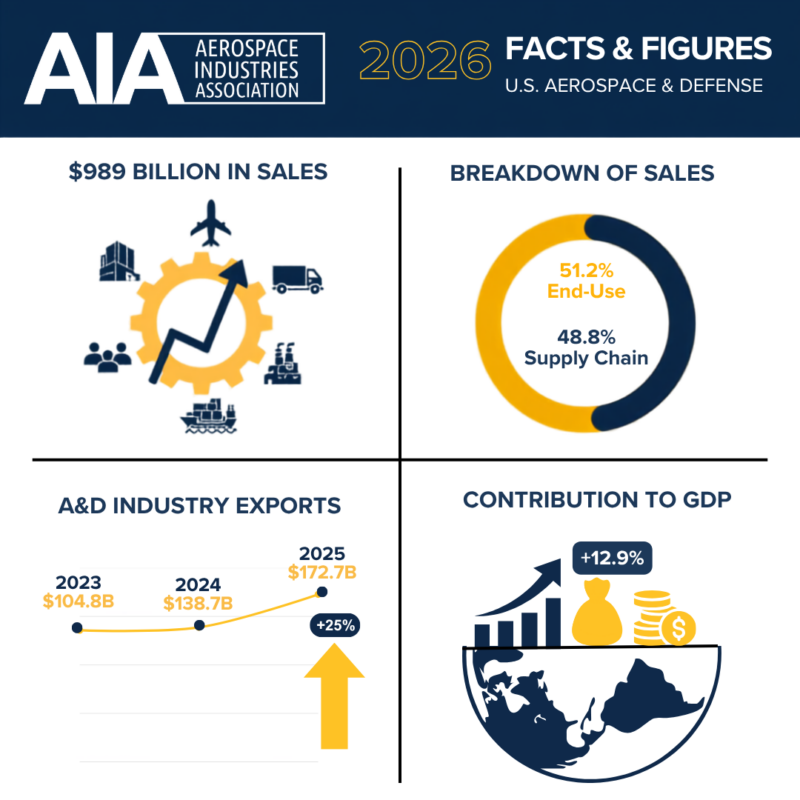
Despite ongoing supply chain pressures and a dynamic global environment, the industry’s workforce generated nearly $1 trillion in total sales in 2025, underscoring its scale and resilience. This sustained strength highlights the industry’s broad economic impact, with activity spanning both end-use manufacturing and a vast domestic supply chain. Additionally, the aerospace and defense industry produced $500 billion in economic value, representing 1.6 percent of total U.S. GDP and reinforcing its role as a key driver of national economic growth.
Leading Trade Activity
AT-A-GLANCE

$109.2B Trade Balance Value

$172.7B Total Exports
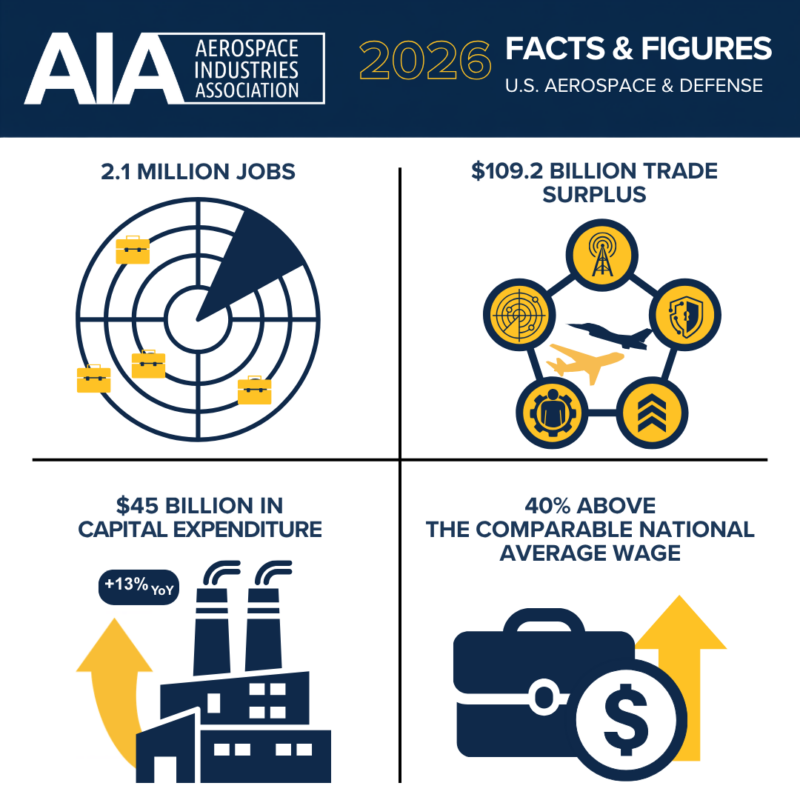
Driven by strong international demand for American-made goods, U.S. aerospace and defense exports reached $172.7 billion in 2025 — helping generate a $109.2 billion trade surplus, the largest of any U.S. manufacturing sector.
The Industry’s Top Trade Partners
From sustainable aviation technologies to defense systems, partners around the world trust American companies to provide the best capabilities at the best value. The leading export destinations in 2025 were China, France, Germany, the United Kingdom, and Brazil.
The leading import destinations were Canada, France, the United Kingdom, Germany, and Mexico.